



Introduction
Today’s children are growing up in a world shaped by technology, innovation, and rapid change.
Traditional classroom instruction continues to provide essential academic foundations, but modern education increasingly focuses on helping students apply knowledge, explore possibilities, and solve problems independently.
STEM education in schools plays an important role in developing these abilities by connecting Science, Technology, Engineering, and Mathematics through practical learning experiences.
When combined with smart classrooms, robotics, coding, and experiential learning, STEM education encourages children to become curious, creative, and confident learners.
What Is STEM Education?
STEM stands for Science, Technology, Engineering, and Mathematics.
Rather than treating these subjects as entirely separate areas, STEM-based learning encourages students to recognise connections between them.
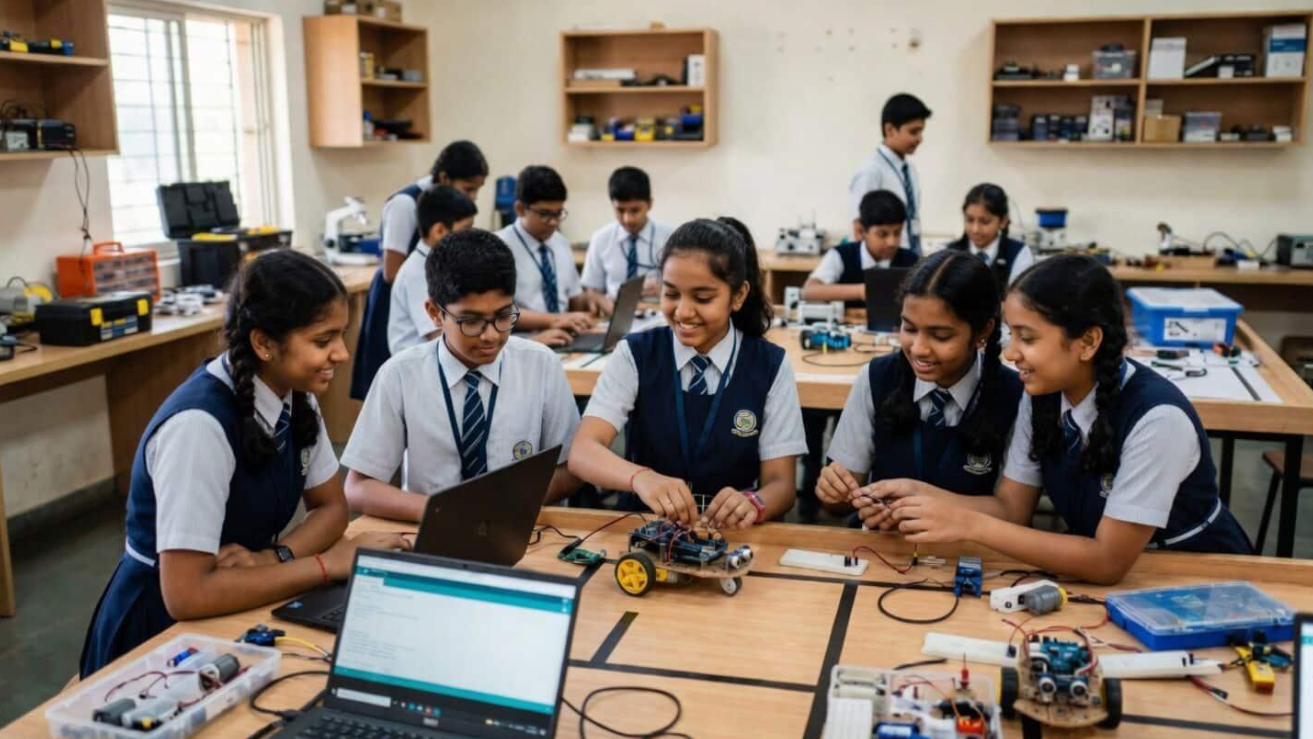
For example, a simple robotics activity may involve scientific understanding, mathematical calculations, engineering design, and computer programming.
By applying knowledge across different subjects, students develop a deeper understanding of how concepts work in real-world situations.
1. Making Learning Interactive Through Smart Classrooms
Smart classrooms use digital teaching tools, visual presentations, interactive displays, and multimedia resources to support classroom instruction.
These technologies can make complex concepts easier to understand by presenting information in different ways.
A science lesson, for example, may become more engaging when students can observe a digital demonstration before participating in practical experiments.
At GT Vidhya Mandir, technology-enabled classrooms are part of the school’s approach to creating an interactive and engaging learning environment.
2. Encouraging Critical Thinking
One of the valuable outcomes of STEM education is the development of critical thinking skills.
Instead of only remembering facts, students are encouraged to investigate questions, analyse information, and evaluate possible solutions.
A classroom activity that asks students to design a simple working model, for example, encourages them to think about how different components function together.
Such experiences help children approach challenges with curiosity and logical reasoning.
3. Developing Problem-Solving Abilities
Problem-solving is an important skill for both academic and everyday success.
STEM-based activities allow students to experiment with ideas, identify mistakes, make adjustments, and test their solutions.
Children learn that discovering why something does not work can be just as valuable as finding the correct answer.
This process encourages patience, perseverance, and independent thinking.
4. Introducing Robotics and Coding
Robotics and coding help students understand how technology works.
Through robotics activities, children can explore mechanical movement, logical sequencing, and practical engineering concepts.
Coding introduces structured thinking and allows students to understand how instructions are used to solve problems.
These learning experiences also encourage creativity, as students explore different ways to complete tasks and design solutions.
5. Strengthening Collaboration and Communication
Innovation rarely happens in isolation.
Many STEM activities involve students working together to plan projects, share responsibilities, discuss ideas, and present their findings.
These collaborative experiences help develop communication, teamwork, leadership, and interpersonal skills.
Students also learn to respect different ideas and understand how shared efforts can lead to stronger outcomes.
6. Connecting Classroom Knowledge With Everyday Life
One of the most meaningful aspects of STEM learning is its connection with the real world.
Science experiments, coding exercises, mathematical investigations, and engineering models allow children to see how their learning applies beyond textbooks.
When students understand the practical relevance of academic concepts, they are more likely to develop curiosity and interest in further exploration.
Preparing Students for Future Opportunities
Future careers may involve technologies and challenges that continue to evolve.
STEM education helps students establish strong foundations in analytical thinking, creativity, adaptability, and problem-solving.
At GT Vidhya Mandir, learning experiences that integrate STEM, robotics, coding, and modern teaching methodologies aim to prepare students for academic success and future opportunities.
The school’s curriculum also incorporates structured conceptual learning designed to strengthen students’ foundations in Mathematics and Science.
Conclusion
Smart classrooms and STEM education represent important approaches to modern learning.
By encouraging experimentation, collaboration, and practical application, they help students develop essential academic and personal skills.
STEM education in schools is not simply about preparing children for technology-related careers. It is about nurturing curiosity, encouraging innovation, and building the confidence to approach unfamiliar challenges.
Through interactive learning and a focus on holistic development, GT Vidhya Mandir strives to empower students with the knowledge, creativity, and confidence needed for the future.